It stands out sharply like an oasis in the desert. Except for the fact that the barren land and shrivelled, dry crops of Wadia do not an oasis make. All around in Banaskantha, fields of lush, green Bajra crop greet the eye — even in these times of drought. The reason: Land in the district is very fertile, yielding bountiful crops of jeera, bajra and even maize.
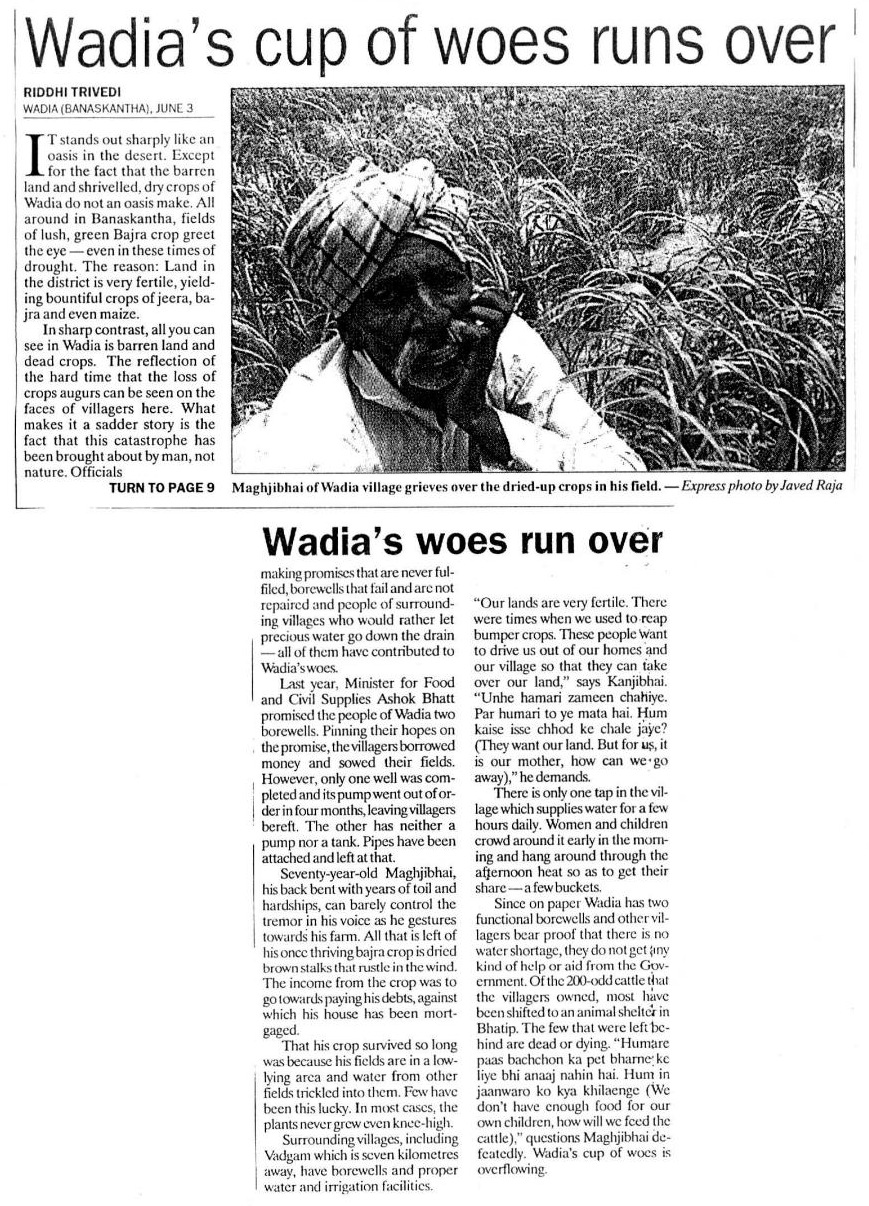
In sharp contrast, all you can see in Wadia is barren land and dead crops. The reflection of the hard time that the loss of crops augurs can be seen on the faces of villagers here. What makes it a sadder story is the fact that this catastrophe has been brought about by man, not nature.
Officials making promises that are never fulfilled, borewells that fail and are not repaired and people of surrounding villages who would rather let precious water go down the drain — all of them have contributed to Wadia's woes.
Last year, Minister for Food and Civil Supplies Ashok Bhatt promised the people of Wadia two borewells. Pinning their hopes on the promise, the villagers borrowed money and sowed their fields. However, only one well was completed and its pump went out of order in four months, leaving villagers bereft. The other has neither a pump nor a tank. Pipes have been attached and left away.
Seventy-year-old Maghjibhai, his back bent with years of toil and hardships, can barely control the tremor in his voice as he gestures towards his farm. All that is left of his once thriving bajra crop is dried brown stalks that rustle in the wind. The income from the crop was to go towards paying his debts, against which his house has been mortgaged.
That his crop survived so long was because his fields are in a low-lying area and water from other fields trickled into them. Few have been this lucky. In most cases, the plants never grew even knee-high.
Surrounding villages, including Vadgam which is seven kilometres away, have borewells and proper water and irrigation facilities.
“Our lands are very fertile. There were times when we used to reap bumper crops. These people want to drive us out of our homes and our village so that they can take over our land,” says Kanjibhai. “Unhe hamari zameen chahiye. Par humari to ye mata hai. Hum kaise isse chhod ke chale jaye? (They want our land. But for us, it is our mother, how can we go away),” he demands.
There is only one tap in the village which supplies water for a few hours daily. Women and children crowd around it early in the morning and hang around through the afternoon heat so as to get their share — a few buckets.
Since on paper Wadia has two functional borewells and other villagers bear proof that there is no water shortage, they do not get any kind of help or aid from the Government. Of the 200-odd cattle that the villagers owned, most have been shifted to an animal shelter in Bhatip. The few that were left behind are dead or dying. “Humare paas bachchon ka pet bharne ke liye bhi anaaj nahin hai. Hum jaanwaro ko kya khilaenge (We don't have enough food for our own children, how will we feed the cattle),” questions Maghjibhai defeatedly. Wadia's cup of woes is overflowing.
 Original Clip