For eight hours a day, 100 days a year, Louis Torres watches cane juice boiling in the evaporators at Cajun Sugar Co-op.
His job is to make sure the conditions are just right for the sugar crystal to be the right size and quality. His knowledge about the process comes from years of experience and from watching three generations of men in his family do the same.
At 52, Torres has been coming to New Iberia to work in the mill for 29 years. Before that, he worked in a sugar mill in Puerto Rico.
“I learned it from my father,” Torres said. “My grandfather used to do the same.”
His uncle and his brother work with him at Cajun Sugar Co-op. Torres comes to Louisiana about six-eight weeks before the start of the grinding season. He checks all the evaporators and makes whatever repairs are necessary.
Once the grinding season begins his job is solely to make sure the right grade, size and purity.
The cane juice is boiled in big evaporators. Each “quad” of evaporators is made up of four “bodies” — the first — with 30,000 square feet of heating surface — works under pressure conditions. The remaining three — with 16,000-square feet of heating surface each — work in vacuum.
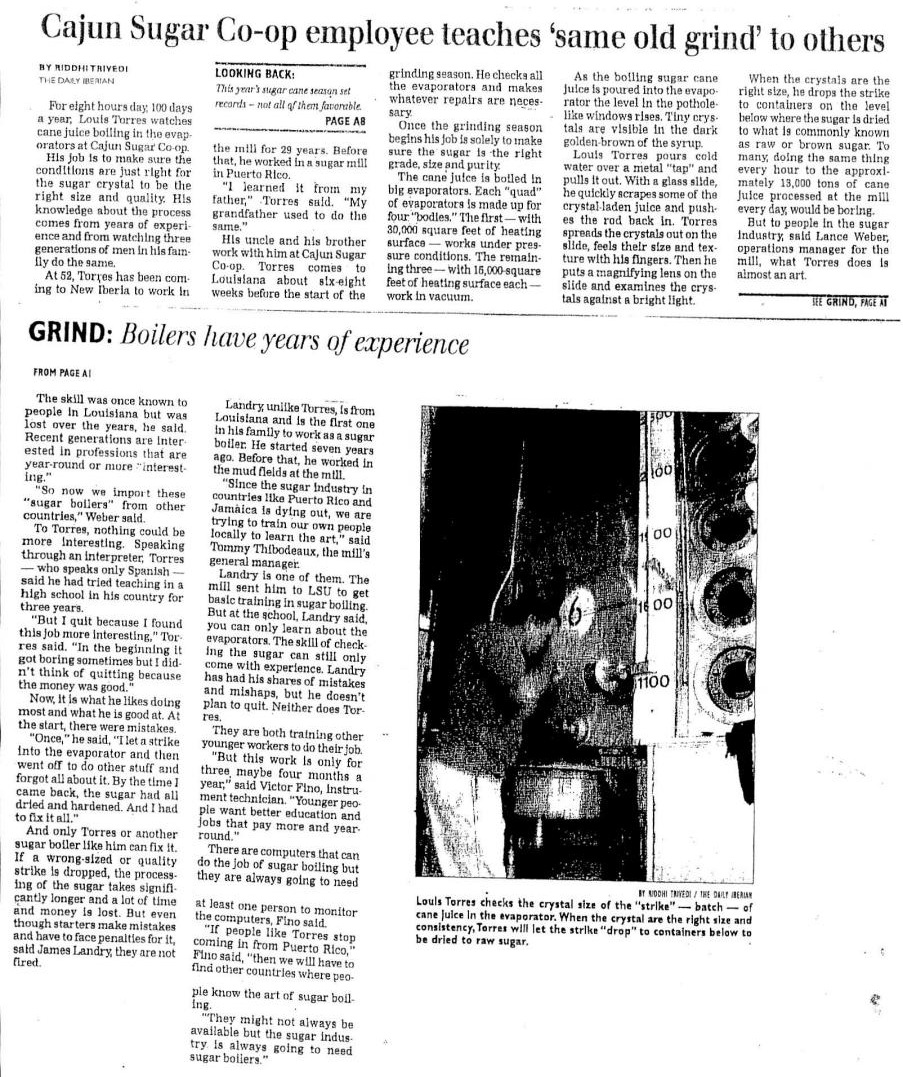
Louis Torres pours cold water over a metal “tap” and pulls it out. With a glass slide, he quickly scrapes some of the crystal-laden juice and pushes the rod back in.
He spreads the crystals out on the slide, feels their size and texture with his fingers. Then he puts a magnifying lens on the slide and examines the crystals against a bright light.
When the crystals are the right size, he drops the strike to containers on the level below where the sugar is dried to what is commonly known as raw or brown sugar. To many, doing the same thing every hour to the approximately 13,000 tons of cane juice processed at the mill every day, would be boring.
But to people in the sugar industry, said Lance Weber, operations manager for the mill, what Torres does is almost an art.
The skill was once known to people in Louisiana but was lost over the years. Recent generations are interested in professions that are year-round or more “interesting.”
“So now we import these ‘sugar boilers' from other countries,” Weber said.
To Torres, nothing could be more interesting. Speaking through an interpreter, Torres — who speaks only Spanish — said he had tried teaching in a high school in his country for three years.
“But I quit because I found this job more interesting,” Torres said. “In the beginning it got boring sometimes but I didn't think of quitting because the money was good.”
Now, it is what he likes doing most and what he is good at. At the start, there were mistakes.
“Once,” he said, “I let a strike into the evaporator and then went off to do other stuff and forgot all about it. By the time I came back, the sugar had all dried and hardened. And I had to fix it all.”
And only Torres or another sugar boiler like him can fix it. If a wrong-sized or quality strike is dropped, the processing of the sugar takes significantly longer and a lot of time and money is lost. But even though starters make mistakes and have to face penalties for it, said James Landry, they are not fired.
They are both training other younger workers to do their job.
“But this work is only for three, maybe four months a year,” said Victor Fino, instrument technician. “Younger people want better education and jobs that pay more and year-round.”
There are computers that can do the job of sugar boiling but they are always going to need at least one person to monitor the computers, Fino said.
“If people like Torres stop coming in from Puerto Rico,” Fino said, “then we will have to find other countries where people know the art of sugar boiling.”
“They might not always be available but the sugar industry is always going to need sugar boilers.”
Landry, unlike Torres, is from Louisiana and is the first one in his family to work as a boiler. He started seven years ago. Before that, he worked in the mud fields at the mill.
“Since the sugar industry in countries like Puerto Rico and Jamaica is dying out, we are trying to train our own people locally to learn the art,” said Tommy Thibodeaux, the mill's general manager.
Landry is one of them. The mill sent him to LSU to get basic training in sugar boiling. But at the school, Landry said, you can only learn about the evaporators. The skill of checking the sugar can still come with experience. Landry has had his shares of mistakes and mishaps, but he doesn't plan to quit. Neither does Torres.
 Original Clip