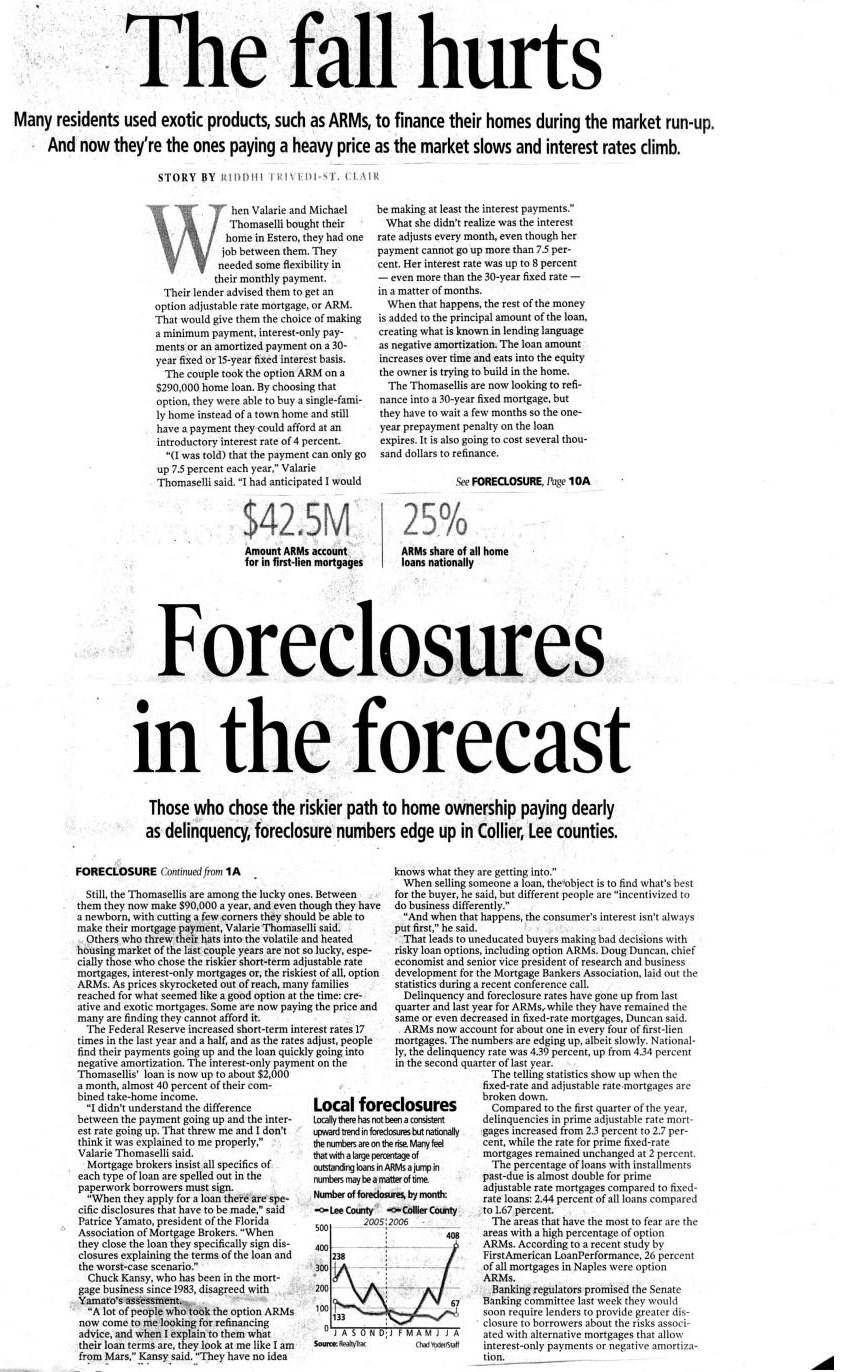
When Valarie and Michael Thomaselli bought their home in Estero, they had one job between them. They needed some flexibility in their monthly payment.
Their lender advised them to get an option adjustable rate mortgage, or ARM. That would give them the choice of making a minimum payment, interest-only payments or an amortized payment on a 30-year fixed or 15-year interest basis.
The couple took the option ARM on a $290,000 home loan. By choosing that option, they were able to buy a single-family home instead of a town home and still have a payment they could afford at an introductory interest rate of 4 percent.
“(I was told that) the payment can only go up 7.5 percent each year,” Valarie Thomaselli said. “I had anticipated I would be making at least the interest payments.”
What she didn't realize was the interest rate adjusts every month, even though her payment cannot go up more than 7.5 percent. Her interest rate was up to 8 percent — even more than the 30-year fixed rate — in a matter of months.
When that happens, the rest of the money is added to the principal amount of the loan, creating what is known in lending language as negative amortization. The loan amount increases over time and eats into the equity the owner is trying to build in the home.
The Thomasellis are now looking to refinance into a 30-year fixed mortgage, but they have to wait a few months so the one-year prepayment penalty on the loan expires. It is also going to cost several thousand dollars to refinance.
Still, the Thomasellis are among the lucky ones. Between them they now make $90,000 a year, and even though they have a newborn, with cutting a few corners they should be able to make their mortgage payment, Valarie Thomaselli said.
Others who threw their hats into the risky, overheated housing market of the last couple years are not so lucky, especially those who chose the riskier short-term adjustable rate mortgages, interest-only mortgages or, the riskiest of all, option ARMs. As prices skyrocketed out of reach, many families reached for what seemed like a good option at the time: creative and exotic mortgages. Some are now paying the price and many are finding they cannot afford it.
The Federal Reserve increased short-term interest rates 17 times in the last year and a half, and as the rates adjust, people find their payments going up and the loan quickly going into negative amortization. The interest-only payment on the Thomasellis' loan is now up to about $2,000 a month, almost 40 percent of their combined take-home income.
“I didn't understand the difference between the payment going up and the interest rate going up. That threw me and I don't think it was explained to me properly,” Valarie Thomaselli said.
Mortgage brokers insist all specifics of each type of loan are spelled out in the paperwork borrowers must sign.
“When they apply for a loan there are specific disclosures that have to be made,” said Patrice Yamato, president of the Florida Association of Mortgage Brokers. “When they close the loan they specifically sign disclosures explaining the terms of the loan and the worst-case scenario.”
Chuck Kansy, who has been in the mortgage business since 1983, disagreed with Yamato's assessment.
“A lot of people who took the option ARMs now come to me looking for refinancing advice, and when I explain to them what their loan terms are, they look at me like I am from Mars,” Kansy said. “They have no idea what they are getting into.”
When selling someone a loan, the object is to find what's best for the buyer, he said, but different people are do business differently.
“And when that happens, the consumer's interest isn't always put first,” he said.
That leads to uneducated buyers making bad decisions with risky loan options, including option ARMs. Doug Duncan, chief economist and senior vice president of research and business development for the Mortgage Bankers Association, laid out the statistics during a recent conference call.
Delinquency and foreclosure rates have gone up from last quarter and last year for ARMs, while they have remained the same or even decreased in fixed-rate mortgages, Duncan said.
ARMs now account for about one in every four first-lien mortgages. Nationally, the delinquency rate was 4.39 percent, up from 4.34 percent in the second quarter of last year.
The telling statistics show up when the fixed-rate and adjustable-rate mortgages are broken down.
Compared to the first quarter of the year, delinquencies in prime adjustable rate mortgages increased from 2.3 to 2.7 percent, while the rate for prime fixed-rate mortgages remained unchanged at 2 percent.
The percentage of loans with installments past-due is almost double for prime adjustable rate mortgages compared to fixed-rate loans: 2.44 percent of all loans compared to 1.67 percent.
The areas that have the most to fear are the areas with a high percentage of option ARMs. According to a recent study by FirstAmerican LoanPerformance, 26 percent of all mortgages in Naples were option ARMs.
Banking regulators promised the Senate Banking committee last week they would soon require lenders to provide greater disclosure to borrowers about the risks associated with alternative mortgages that allow interest-only payments or negative amortization.
 Original Clip