Density bonuses were expected to lure developers into helping Lee and Collier counties land the prized but elusive catch — affordable housing.
The bait hasn't proven juicy enough.
After more than a decade of offering incentives, tweaking formulas and looking for ways to trim their programs, density bonus plans in Lee and Collier counties haven't kept up with affordable housing demand.
Lee County's program has failed to generate more than a handful of affordable homes, while Collier County is creating some 500 units per year using density bonuses, according to county figures.
That compares to a need for more than 30,000 affordable housing units in Lee County. In Collier County, an estimated 34,000 households are living in unaffordable housing. That doesn't include workers who live out of the county because they can't afford to live in Collier.
“I don't think the density bonus on its own is the silver bullet to meet the need,” Collier County housing and grants manager Cormac Giblin said.
Density bonuses are designed to make affordable housing more attractive to a developer's bottom line.
Developers have to build a certain number of homes to be sold for a certain price in order to make a profit after taking into account the cost of the land, financing costs and the cost of materials and labor.
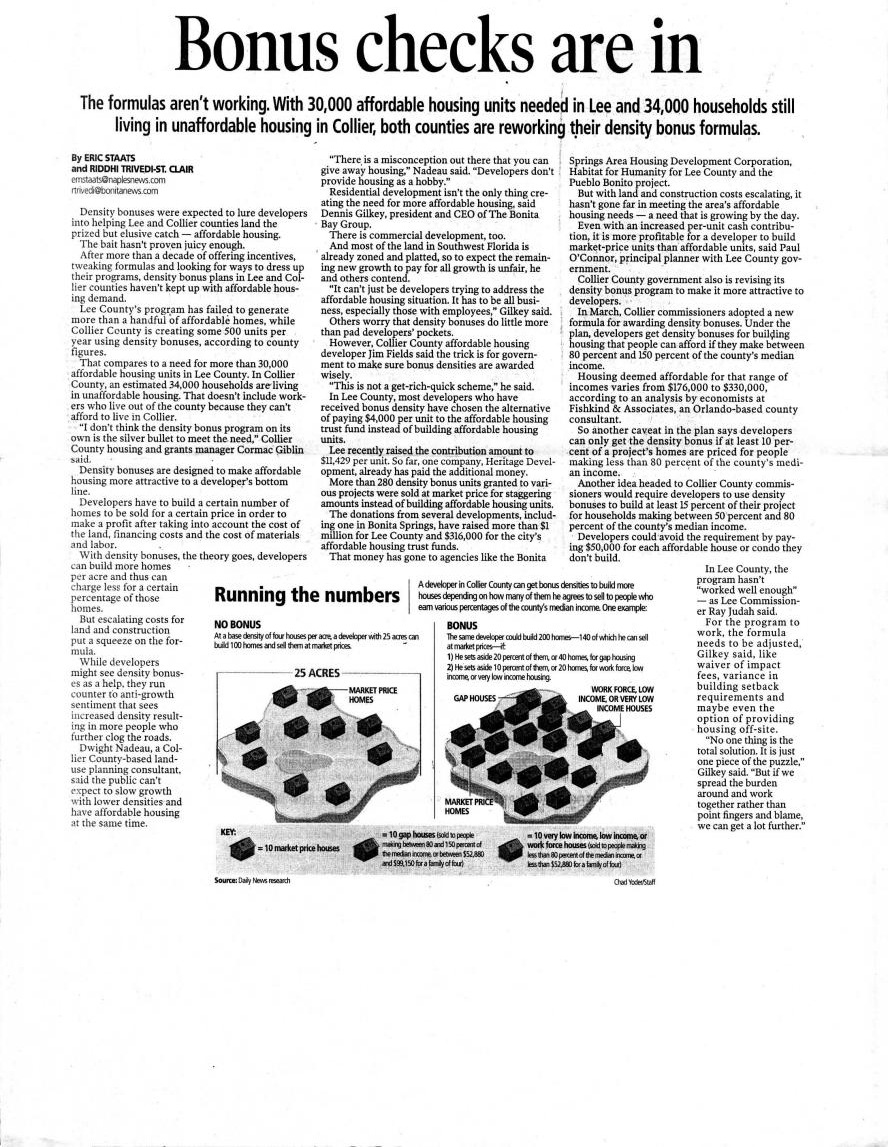
With density bonuses, the theory goes, developers can build more homes per acre and thus can charge less for a certain percentage of those homes.
But escalating costs for land and construction put a squeeze on the formula.
While developers might see density bonuses as a help, they run counter to anti-growth sentiment that sees increased density resulting in more people who further clog the roads.
Dwight Nadeau, a Collier County-based land-use planning consultant, said the public can't expect to slow growth with lower densities and have affordable housing at the same time.
“There is a misconception out there that you can give away housing,” Nadeau said. “Developers don't provide housing as a hobby.”
Residential development isn't the only thing creating the need for more affordable housing, said Dennis Gilkey, president and CEO of The Bonita Bay Group.
There is commercial development, too.
And most of the land in Southwest Florida is already zoned and platted, so to expect the remaining new growth to pay for all growth is unfair, he and others contend.
“It can't just be up to developers to address the affordable housing situation. It has to be all business,” Gilkey said. Others worry that density bonuses do little more than pad developers' pockets.
However, Collier County affordable housing developer Jim Fields said the trick is for government to make sure bonus densities are awarded wisely.
“This is not a get-rich-quick scheme,” he said.
In Lee County, most developers who have received bonus density have chosen the alternative of paying $4,000 per unit to the affordable housing trust fund instead of building affordable housing units.
Lee County recently raised the contribution amount to $11,429 per unit, he said. For one company, Heritage Development, already has paid the additional money.
More than 280 density bonus units granted to various projects were sold at market price with the county requiring of paying $4,000 for them, or 20 percent of them, for gap housing instead of building affordable housing units.
That money has gone to agencies like the Bonita Springs Area Housing Development Corporation, Habitat for Humanity for Lee County and the Pueblo Bonito project.
But with land and construction costs escalating, it hasn't gone far in meeting the area's affordable housing needs — a need that is growing by the day.
Even with an increased per-unit cash contribution, it is more profitable for a developer to build market-price units than affordable units, said Paul O'Connor, principal planner with Lee County government.
Collier County government also is revising its density bonus program to make it more attractive to developers.
In March, Collier commissioners adopted a new formula for awarding density bonuses. Under the plan, developers get density bonuses for building housing that people can afford if they make between 80 and 150 percent of the county's median income.
Housing deemed affordable for that range of incomes varies from $176,000 to $330,000, according to an analysis by economists at Fishkind & Associates, an Orlando-based economic consultant.
So another caveat in the plan says developers can only get the density bonus if at least 10 percent of a project's homes are priced for people making less than 80 percent of the county's median income.
Another idea floated to Collier County commissioners would require developers to use density bonuses to build for at least 15 percent of their project for households making between 50 percent and 80 percent of the county's median income.
Developers could avoid the requirement by paying $50,000 for each affordable house or condo they don't build.
In Lee County, the program hasn't “worked well enough” — as Lee Commissioner Ray Judah said.
For the program to work, the formula needs to be adjusted, Gilkey said, like the waiver of impact fees, variance in building setback requirements and maybe even the option of providing housing off-site.
“No one thing is the total solution. It is just one piece of the puzzle,” Gilkey said. “But if we spread the burden around and work together rather than point fingers and blame, we can get a lot further.”
 Original Clip