While bureaucrats and politicians try to find out more about drip irrigation and other such techniques from Israel and other countries, they are neglecting something sitting in their own backyard for ages. Archaeologists in Patan have excavated 500-year-old remains of an irrigation system that the state can be proud of. Something tourists from all over the world take pains to come down and look at. However, this heritage today is in a shambles today as authorities refuse to give it the required attention.
The Shahastraling Talav and Rani-ki-vav date back to the Solanki era. This was a period when Gujarat became very prosperous with its boundaries reaching far and wide.
The Shahastraling Talav, constructed to divert water from the Saraswati river to the city and store it for the dry months, is a perfect example of the irrigation techniques used during the period. Says Harish Patel of the Archaeological Survey of India (ASI), “Shahastra means a thousand and eight. It is said that at one time, around the boundaries of the lake, there were one thousand and eight temples. The biggest of them was of Lord Shiva.”
The lake is based on the simple principle of letting water in through an inlet joined to the river. The water is stored in a big reservoir. An outlet is provided to let water out and make room for fresh water during monsoons.
Archaeologists say two natural calamities — a flood and then a sandstorm, evidences of which have been found in the sediments — caused the lake to get covered.
Localites, however, believe differently. This belief has now reached folk proportions. Legend has it that the king was besotted by Jasma Odhan a worker on the site of the lake and resorted to foul means to possess her. He got her entire family killed. Outraged and heartbroken, she cursed the king that his dream lake would never be completed.
Patel believes the lake was a thing of beauty during its heyday. “In the centre of the lake was a place for the king and queen to rest in the afternoon. When aarti began in the evenings the lamps reflected in the water where swans swam. It is said even Kashmir was dimmed by the splendour of the sight.”
Only one per cent of it has been excavated so far. A plan of action for the excavation of the remaining area was put to the government but did not see the light of day, apparently for the lack of funds.
The Rani-ki-vav, a seven-storey sandstone structure built in 1022-1066, is about 64 metres long, 20 metres wide and 27 metres deep. Different aspects of life have been depicted in different galleries. The shastras too have been presented in all their pristine glory. The Apsara gallery has 32 women figures intricately carved out. The sculptures vary from the various avataars of lord Rama to the different phases of life.
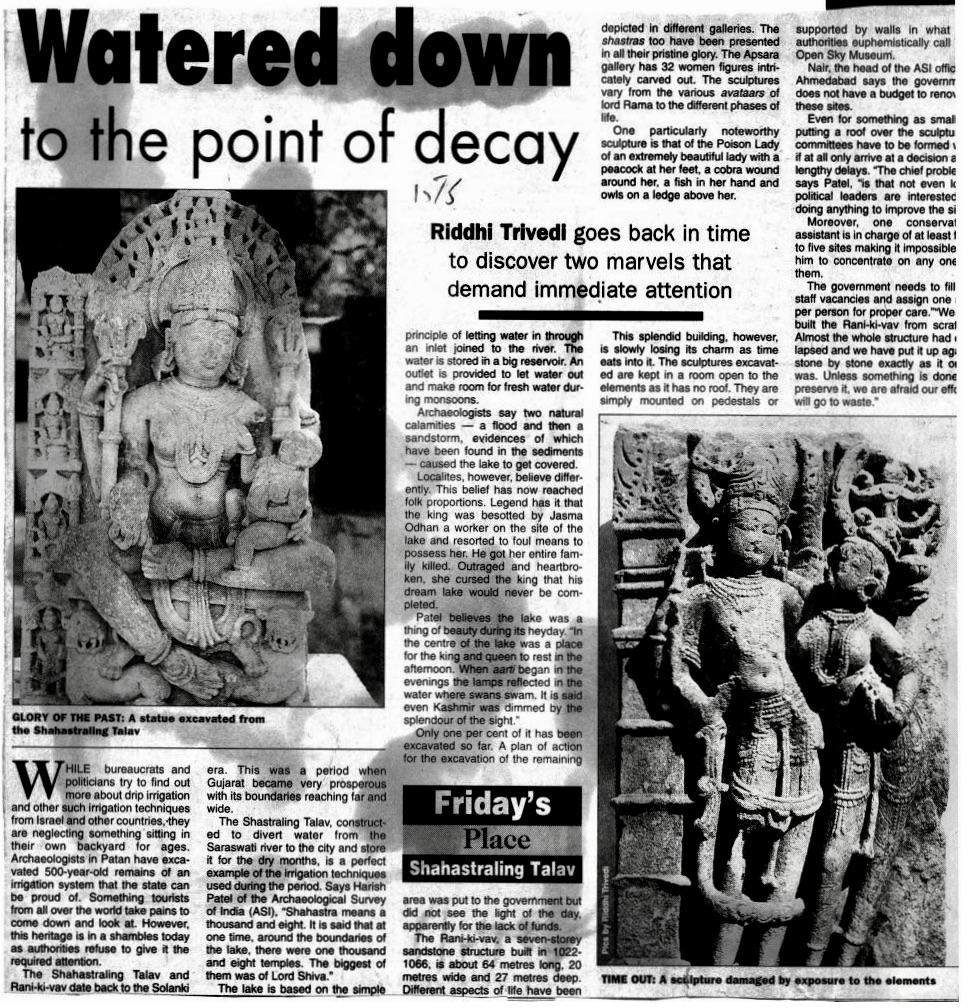
One particularly noteworthy sculpture is that of the Poison Lady of an extremely beautiful lady with a peacock at her feet, a cobra wound around her, a fish in her hand and owls on a ledge above her.
This splendid building, however, is slowly losing its charm as time eats into it. The sculptures excavated are kept in a room open to the elements as it has no roof. They are simply mounted on pedestals or supported by walls in what authorities euphemistically call Open Sky Museum.
Nair, the head of the ASI office in Ahmedabad says the government does not have a budget to renovate these sites.
Even for something as small as putting a roof over the sculpture, committees have to be formed which, if at all only arrive at a decision after lengthy delays. “The chief problem,” says Patel, “is that not even local political leaders are interested in doing anything to improve the site.”
Moreover, one conservation assistant is in charge of at least five sites making it impossible for him to concentrate on any one of them.
The government needs to fill staff vacancies and assign one per person to care properly. “We built the Rani-ki-vav from scratch. Almost the whole structure had lapsed and we have put it up again stone by stone exactly as it was. Unless something is done to preserve it, we are afraid our efforts will go to waste.”
 Original Clip