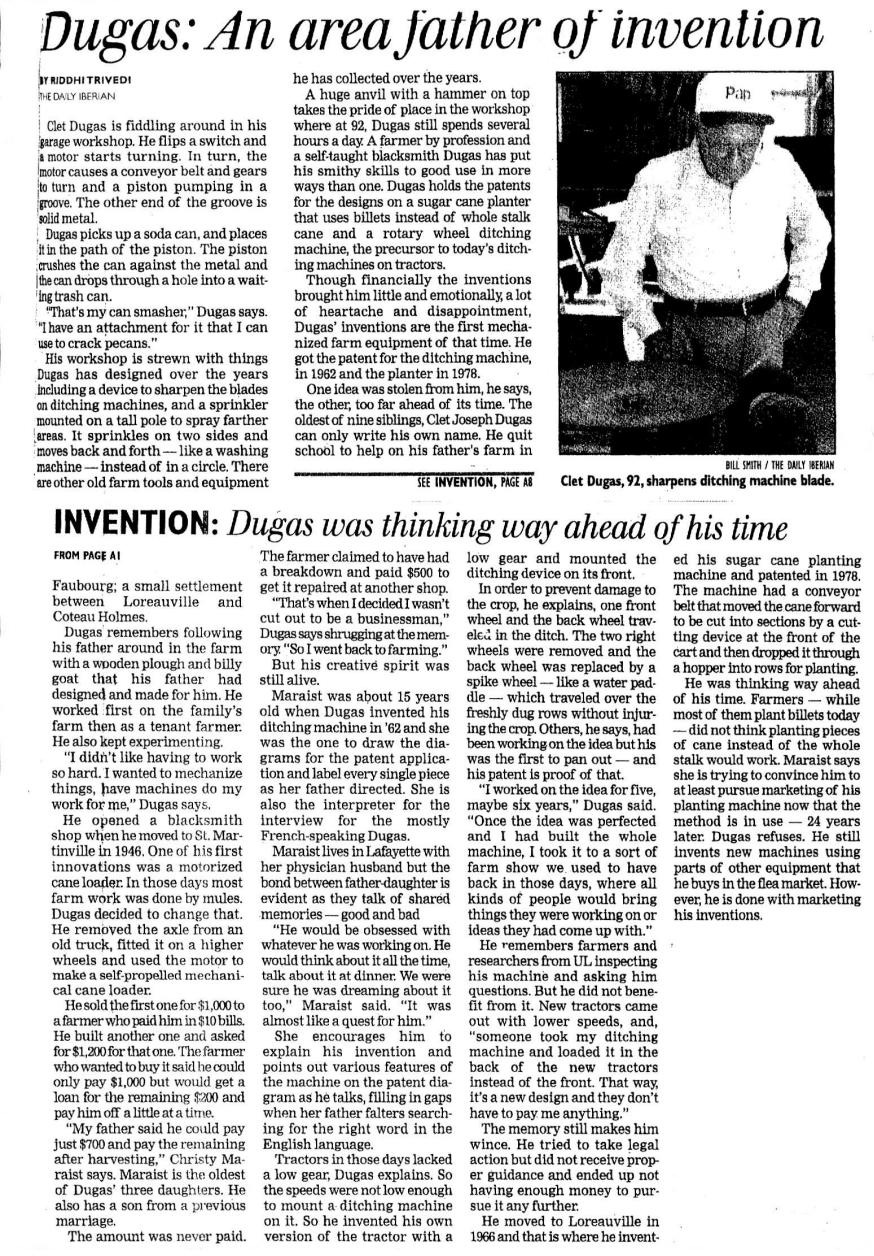
Clet Dugas is fiddling around in his garage workshop. He flips a switch and a motor starts turning. In turn, the motor causes a conveyor belt and gears to turn and a piston pumping in a groove. The other end of the groove is solid metal.
Dugas picks up a soda can, and places it in the path of the piston. The piston crushes the can against the metal and the can drops through a hole into a waiting trash can.
“That's my can smasher,” Dugas says. “I have an attachment for it that I can use to crack pecans.”
His workshop is strewn with things Dugas has designed over the years including a device to sharpen the blades on ditching machines, and a sprinkler mounted on a tall pole to spray farther areas. It sprinkles on two sides and moves back and forth — like a washing machine — instead of in a circle. There are other old farm tools and equipment he has collected over the years.
A huge anvil with a hammer on top takes the pride of place in the workshop where at 92, Dugas still spends several hours a day. A farmer by profession and a self-taught blacksmith, Dugas has put his smithy skills to good use in more ways than one. Dugas holds the patents for the designs on a sugar cane planter that uses billets instead of whole stalk cane and a rotary wheel ditching machine, the precursor to today's ditching machines on tractors.
Though financially the inventions brought him little and emotionally a lot of heartache and disappointment, Dugas' inventions are the first mechanized farm equipment of that time. He got the patent for the ditching machine in 1962 and the planter in 1978.
One idea was stolen from him, he says, the other, too far ahead of its time. Dugas, the oldest of nine siblings, could only write his own name. He quit school to help on his father's farm in Faubourg, a small settlement between Loreauville and Coteau Holmes.
Dugas remembers following his father around the farm with a wooden plough and billy goat that his father had designed and made for him. He worked first on the family's farm then as a tenant farmer. He also kept experimenting.
“I didn't like having to work so hard. I wanted to mechanize things, have machines do my work for me,” Dugas says.
He opened a blacksmith shop when he moved to St. Martinville in 1946. One of his first innovations was a motorized cane loader. In those days most farm work was done by mules. Dugas decided to change that. He removed the axle from an old truck, fitted it on a higher wheeled axle and used the motor to make a self-propelled mechanical cane loader.
He sold the first one for $1,000 to a farmer who paid him in $10 bills. He built another one and asked for $1,200 for that one. The farmer who wanted to buy it said he could only pay $1,000 but would get a loan for the remaining $200 and pay him off a little at a time.
“My father said he could pay just $700 and pay the remaining after harvesting,” Christy Maraist says. Maraist is the oldest of Dugas' three daughters. He also has a son from a previous marriage.
The amount was never paid. The farmer claimed to have had a breakdown and paid $500 to get it repaired at another shop.
“That's when I decided I wasn't cut out to be a businessman,” Dugas says shrugging at the memory. “So I went back to farming.”
But his creative spirit was still alive. Maraist was about 15 years old when Dugas invented the ditching machine in '62 and she was the one to draw the diagrams for the patent application and label every single piece as her father directed. She is also the interpreter for the interview for the mostly French-speaking Dugas.
Maraist lives in Lafayette with her physician husband but the bond between father-daughter is evident as they talk of shared memories — good and bad.
“He would be obsessed with whatever he was working on. He would think about it all the time, talk about it at dinner. We were sure he was dreaming about it too,” Maraist said. “It's almost like a quest for him.”
She encourages him to explain his invention and points out various features of the machine on the patent diagram as he talks, filling in gaps when her father falters searching for the right word in the English language.
Tractors in those days lacked a low gear. So the speeds were not low enough to mount a ditching machine on it. So he invented his own version of the tractor with a low gear and mounted the ditching device on its front.
In order to prevent damage to the crop, he explains, one front wheel and the back wheel traveled in the ditch. The two right wheels were removed and replaced by a spike wheel — like a water paddle — which traveled over the freshly dug rows without injuring the crop. Others, he says, had his been working on the idea but his was the first to pan out — and his patent is proof of that.
“I worked on the idea for five, maybe six years,” Dugas said. “Once the idea was perfected and I had built the whole machine, I took it to a sort of farm show we used to have back in those days, where all kinds of people would bring things they were working on or ideas they had come up with.”
He remembers farmers and researchers from UL inspecting his machine and asking him questions. But he did not benefit from it. New tractors came out with lower speeds and, “someone took my ditching machine and loaded it in the back of the new tractors instead of the front. That way, it's a new design and they don't have to pay me anything.”
The memory still makes him wince. He tried to take legal action but did not receive proper guidance and ended up not having enough money to pursue it any further.
He moved to Loreauville in 1966 and that is where he invented his sugar cane planting machine and patented it in 1978. The machine had a conveyor belt that moved the cane forward to be cut into sections by a cutting device at the front of the cart and then dropped through a hopper into rows for planting.
He was thinking way ahead of his time. Farmers — while most of them plant billets today — did not think planting pieces of cane instead of the whole stalk would work. Christy Maraist says she is trying to convince him to at least pursue marketing the planting machine now that the method is in use — 24 years later. Dugas refuses. He still invents new machines using parts of other equipment that he buys in the flea market. However, he is done with marketing his inventions.
 Original Clip