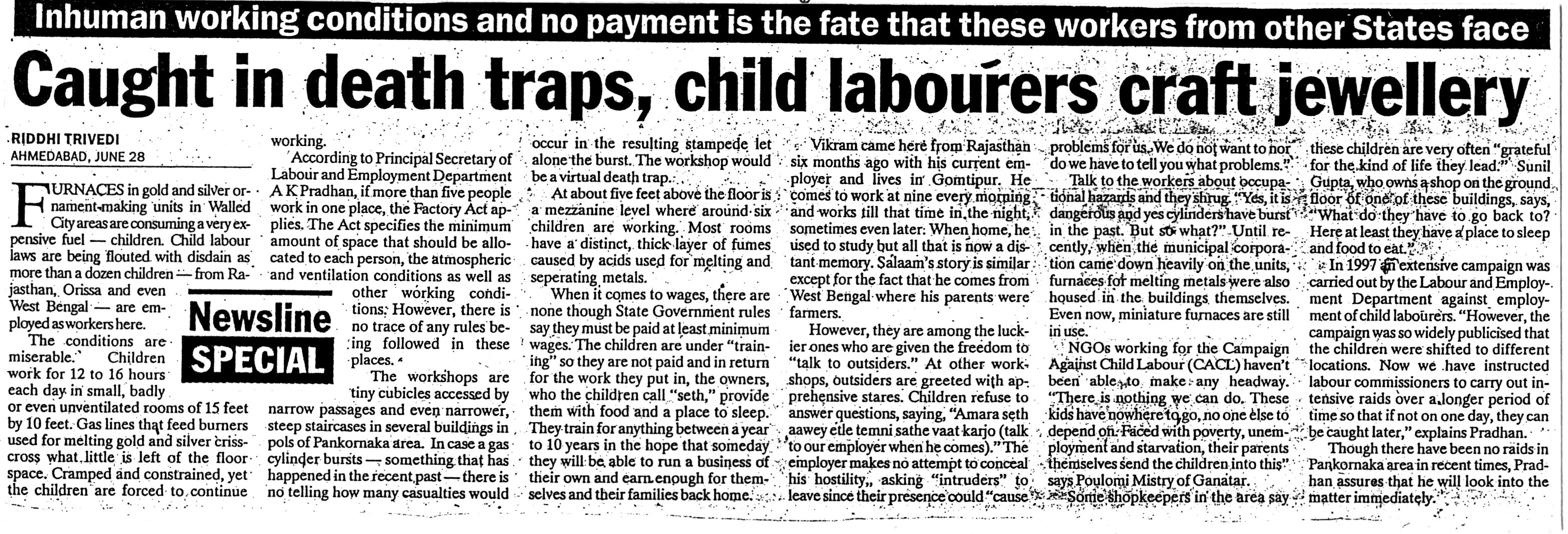
Furnaces in gold and silver ornament-making units in Walled City areas are consuming a very expensive fuel — children. Child labour laws are being flouted with disdain as more than a dozen children — from Rajasthan, Orissa and even West Bengal — are employed as workers here.
The conditions are miserable. Children work 12 to 16 hours each day in small, badly or even unventilated rooms of 15 feet by 10 feet. Gas lines that feed burners used for melting gold and silver criss-cross what little is left of the floor space. Cramped and constrained, yet the children are forced to continue working.
According to Principal Secretary of Labour and Employment Department A K Pradhan, if more than five people work in one place, the Factory Act applies. The Act specifies the minimum amount of space that should be allocated to each person, the atmospheric and ventilation conditions as well as other working conditions. However, there is no trace of any rules being followed in these places.
The workshops are tiny cubicles accessed by narrow passages and even narrower, steep staircases in several buildings in the Pankornaka area. In case a gas cylinder bursts — something that has happened in the recent past — there is no telling how many casualties would occur in the resulting stampede let alone the burst. The workshop would be a virtual death trap.
At about five feet above the floor is a mezzanine level where around six children are working. Most rooms have a distinct, thick layer of fumes caused by acids used for melting and separating metals.
When it comes to wages, there are none though State Government rules say they must be paid at least minimum wages. The children are under “training” so they are not paid and in return for the work they put in, the owners, who the children call “seth,” provide them with food and a place to sleep. They train for anything between a year to 10 years in the hope that someday they will be able to run a business of their own and earn enough for themselves and their families back home.
Vikram came here from Rajasthan six months ago with his current employer and lives in Gomtipur. He comes to work at nine every morning and works till that time in the night, sometimes even later. When home, he used to study, but all that is now a distant memory.
Salaam's story is similar, except for the fact that he comes from West Bengal, where his parents are farmers.
However, they are among the luckier ones who are given the freedom to “talk to outsiders.” At other workshops, outsiders are greeted with apprehensive stares. Children refuse to answer questions, saying, “Amara seth aawey etle temni sathe vaat karjo (talk to our employer when he comes).” The employer makes no attempt to conceal his hostility, asking “intruders” to leave since their presence could cause problems for us. We do not want to hear it, nor do we have to tell you what the problems are.
Talk to the workers about occupational hazards and they shrug. “Yes, it is dangerous and yes cylinders have burst in the past. But so what?” Until recently, when the municipal corporation came down heavily on the units, furnaces for melting metals were also housed in the buildings themselves. Even now, miniature furnaces are still in use.
NGOs working for the Campaign Against Child Labour (CACL) haven't been able to make any headway. “There is nothing we can do. These kids have nowhere to go, no one else to depend on. Faced with poverty, unemployment and starvation, their parents themselves send the children into this,” says Poulomi Mistry of Ganatar.
Some shopkeepers in the area say that these children are very often “grateful” for the kind of life they lead. Sunil Gupta, who owns a shop on the ground floor of the building, says, “What do they have to go back to? Here at least they have a place to sleep and food to eat.”
In 1997 an extensive campaign was carried out by the Labour and Employment Department against employment of child labourers. “However, the campaign was so widely publicised that the children were shifted to different locations. Now we have instructed labour commissioners to carry out intensive raids over a longer period of time so that if not on one day, they can be caught later,” explains Pradhan.
Though there have been no raids in Pankornaka area in recent times, Pradhan assures that he will look into the matter immediately.
 Original Clip